SELECTMEN
Benjamin Brown
Lt. Benjamin Flint
Mr. Abraham Sheldin [Sheldon]
Lt. Jonas Parker
Lt. James Bancroft
Reading's select board was established circa 1647, and it typically consisted of three to five prominent local landowners who wielded administrative control over the community.
Their responsibilities included:
Setting Town Agendas: Selectmen held sole authority to schedule Town Meetings and draft the "warrants" — the list of specific issues and articles to be debated and voted on by residents qualified to vote.
Financial Management: Selectmen determined local tax rates, oversaw tax collections, and authorized the payment of town bills and expenditures.
Land and Agriculture Regulation: Selectmen resolved boundary and land disputes between neighbors, monitored livestock roaming, and maintained public spaces.
Public Infrastructure: Selectmen directed the building and maintenance of public infrastructure like roads, bridges, and the local meetinghouse.
Social and Religious Surveillance: Operating closely with the Congregational Church, Selectmen monitored community morals, enforced mandatory church attendance, and oversaw early public education.
Social Services and "Warning Out": Selectmen managed the care for the local poor and supervised the placement of neglected children. They protected town budgets by "warning out" (expelling) incoming, non-resident transients who might become a financial burden on the community.
Appointing Local Officers: Selectmen appointed town officials who were not directly elected, such as constables, highway supervisors, and field drivers.
Source: Genealogical History of the Town of Reading, Mass, Hon. Lilley Eaton
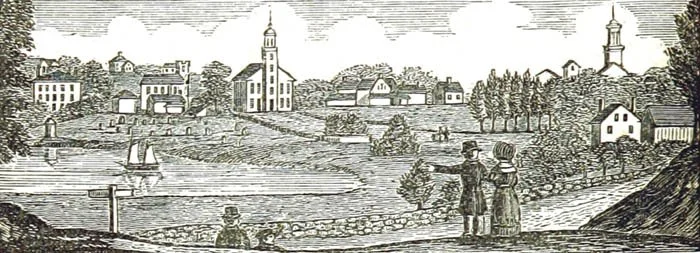
Town Officials in 1776
Main Menu — From Loyal to Defiance: Town Meeting Minutes — Cost of Revolution — Houses Standing in 1776
OVERSEERS OF THE POOR
Col. David Green
Capt. John Goodwin
Capt. Hezekiah Upton
Samuel Bancroft, Esq.
Mr. Daniel Parker
In colonial Reading, Massachusetts, the responsibilities of the Overseers of the Poor were managed directly by the elected town Selectmen.
Under Massachusetts provincial laws enacted in 1692, local governments bore full financial and legal responsibility for supporting their destitute residents. In Reading, the Selectmen acting as overseers managed public welfare through specific, traditional mechanisms.
Their responsibilities included:
Legal Settlement Laws: Relief was restricted strictly to individuals with legal "settlement" (residency rights) in Reading. Proving residency depended on birth, parentage, marriage, or formal town acceptance.
Warning-Out: To prevent transient or impoverished newcomers from becoming a financial burden on local taxpayers, Selectmen and constables enforced the "warning-out" process, legally requiring outsiders to leave the town.
Outdoor Relief and Boarding: Reading did not maintain a large colonial almshouse or workhouse initially. Instead, the town provided "outdoor relief" (supplying food, firewood, or clothing) or paid local families and farmers a stipend to board the infirm, elderly, or orphaned.
Apprenticeship (Indentures): The Selectmen were authorized to remove children from impoverished or unstable homes and bind them out as indentured apprentices to learn a trade and basic literacy. Surviving records note local apprenticeships tied to Reading residents during the 1700s.
Sources: https://www.colonialsociety.org/node/3083; https://archives.bpl.org/repositories/2/resources/139;
COMMITTEE OF CORRESPONDENCE
Deacon Jacob Emerson
Capt. John Flint
Mr. Ephraim Parker
Capt. John Walton
Mr. George Flint
Committees of correspondence were longstanding colonial institutions that became a key communications system during the early years of the American Revolution (1772–1776). Towns, counties, and colonies from Nova Scotia to Georgia had their own committees of correspondence. Men on these committees wrote to each other to express ideas, to confirm mutual assistance, and to debate and coordinate resistance to British imperial policy. The network created by committees of correspondence organized and mobilized hundreds of communities across the British North American colonies. Though George Washington was never a member of a committee of correspondence, he interacted with them regularly when he was elected to the House of Burgesses and as Commander-and-Chief of the Continental Army.
CONSTABLES
Ens. William Sawyer Jr.
Mr. John Nichols
Mr. John Vinton
Mr. Peter Emerson
Mr. Benjamin Upton
Lt. Jonathan Pool [Poole]
Operating alongside town Selectmen, a colonial constable held broad common-law authority as the primary local peace officer.
Their responsibilities included:
Maintaining Order: Constables kept the King's peace, broke up disturbances, and managed community safety.
Enforcing Laws: Constables apprehended suspects, executed warrants, and guarded prisoners.
Civic Administration: Constables warned town meetings, helped oversee elections, and collected local taxes.
Serving Process: Constables delivered court summons, subpoenas, and legal notices much like modern process servers.
Source: https://www.constables-mbca.org/origins-of-police-in-massachusetts.php
LATHER CELER
Mr. Joseph Emerson
In colonial Reading, Massachusetts, a Lather Celer (Sealer of Leather) was an officially appointed or elected town officer responsible for inspecting, testing, and stamping (sealing) all locally produced leather to ensure it met strict legal quality standards.
Because leather was a vital cornerstone of the colonial economy — critical for making boots, shoes, harnesses, blacksmith aprons, and military gear — the Massachusetts Bay Colony heavily regulated its production to prevent fraud and poor craftsmanship.
His responsibilities included:
Quality Control: The sealer examined hides processed by local tanners and curriers to ensure they were properly tanned, thoroughly dried, and not stretched or weakened to artificially increase their size.
The Official Stamp: If the leather passed inspection, the official applied an iron "G" stamp or a wax seal. This mark served as a consumer protection guarantee, signaling that the material was durable and fit for sale.
The "G" Stamp: stamped onto leather deemed "Good" and thoroughly tanned/dried.
The "B" Stamp: stamped onto leather deemed "Bad" or faulty (insufficiently tanned, over-heated, or damaged).
Enforcement & Fines: Unsealed leather could not be legally sold or worked into consumer goods. If a tanner attempted to sell substandard or uninspected hides, the sealer was authorized to seize the inventory and issue a fine.
SURVAIRS OF BORDS AND SHINGLS
Mr. Peter Emerson
Mr. John Flint
In colonial New England, a Survair of Bords and Shingls (Surveyor of Boards and Shingles) was a vital municipal officer appointed or elected during annual town meetings. In colonial Reading, as in other heavily forested early settlements, this civil servant functioned as a quality control inspector and standardizer for the local timber industry.
Colonial towns relied heavily on wood for constructing homes, ships, and export barrels. To ensure fair trade and structurally sound buildings, the Massachusetts Bay Colony passed laws requiring towns to appoint specialized timber inspectors.
Their responsibilities included:
Enforcing Standardization: Surveyors of Boards and Shingles verified that manufactured boards, clapboards, and shingles met legally established dimensions (such as standard thickness and length) before they could be bought, sold, or shipped.
Quality Grading: Surveyors of Boards and Shingles inspected building materials for defects like rot, excessive knots, or warping, ensuring buyers were not cheated by dishonest lumber mill operators.
Preventing Export Fraud: Because timber was a primary economic currency exported to Europe and the Caribbean, high-quality standards were strictly protected to maintain the colony's trade reputation.
FIELD DRIVERS
Mr. Thomas Damon
Mr. James Foster
Mr. John Temple
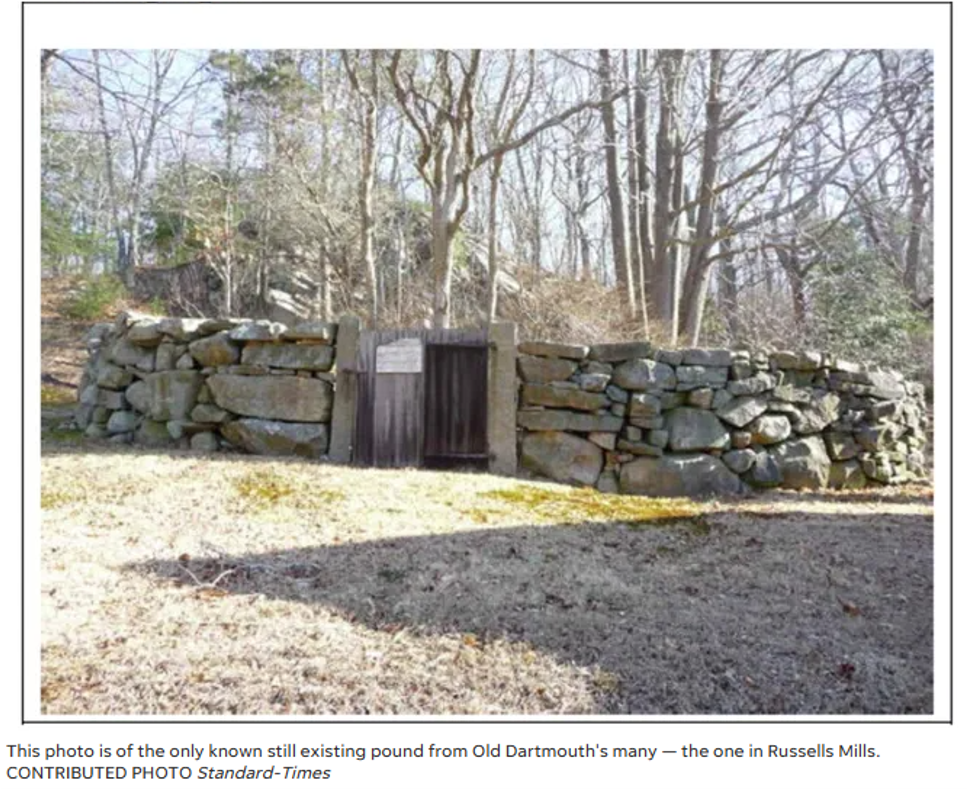
Field Drivers drove errant critters into a communal enclosure to hold until the owner could pay the fine and reclaim them. The photo below is an example of a communal enclosure in Dartmouth, MA.
FISH COMMITTEE
Jonathan Poole Jr.
Pawl [Paul] Sweetser
Daniel Graves Jr.
In colonial Reading, Massachusetts, the primary role of the Fish Committee was to regulate, protect, and manage the seasonal migration of fish, specifically alewives (river herring, pictured below).
These fish migrated from the ocean up the Saugus River to spawn in Reading Pond (now Lake Quannapowitt in modern-day Wakefield). Because these seasonal fish runs were a vital source of protein, agricultural fertilizer, and trade for early settlers, managing them was a critical function of local town government.
Image source: https://www.fisheries.noaa.gov/species/river-herring

DEAR RIEFS
Lt. Elazar [Eliezer] Flint
Mr. Abraham Foster
A dear rief (deer reeve) in 1776 was a town-appointed game warden responsible for enforcing deer hunting laws and protecting wildlife populations. Reeve is a traditional English term meaning official or overseer.
Deer reeves represented some of the earliest conservation and environmental policing efforts in American history. Some of the earliest hunting and fishing laws date back to 1627 when the Colony of New Plymouth created a law that declared hunting, fowling, and fishing shall be free. The Massachusetts Bay Colony also declared hunting and fishing to be free in 1641. (Source)
Their duties included:
Enforcing Closed Seasons: To combat the rapid decline of the white-tailed deer caused by overhunting and the commercial skin trade, colonies established "closed seasons." For example, in Massachusetts, deer reeves were mandated to ensure no one hunted deer or moose between late December and mid-August.
Prosecuting Violators: Deer reeves were legally sworn town officers. They patrolled town lands, identified poachers, tracked illegal venison or hides, and brought offenders before local courts to be fined.
Mandatory Appointments: Deer reeves were so critical to preserving food and trade stability that colonial governments heavily fined towns that failed to elect or appoint their required deer reeves.
SURVAIRS OF HIGHWAYS
Josiah Walton
Jonathan Poole Jr.
Ens. Ebenezer Hopkinson
Stephan [Stephen] Buxton
Ephraim Pratt
Elijah Upton
Samuel Damon
John Goodwin Jr.
Samuel Pratt
Colonial survairs (surveyors) of highways in Massachusetts were vital elected town officials responsible for laying out, clearing, and maintaining local roads, bridges, and causeways.
Their responsibilities included:
Town Officials: Towns elected one or more surveyors annually, holding an office of high respect and importance on par with constables and tax collectors.
Route Planning: Surveyors determined the best paths for new dirt tracks and major highways connecting local settlements.
Mandatory Labor: Surveyors had the legal authority to call upon able-bodied town residents to perform mandatory annual road work (often four to six days a year).
Enforcement: Surveyors tracked who completed their required labor and levied fines against residents who neglected their maintenance duties.
Sources: digitized Diary of John Adams, volume 3, Massachusetts Historical Society; https://www.fairbankshistory.com/colonial-history/it-takes-a-village-fairbanks-role-in-development-of-early-dedham-massachusetts-part-i; https://www.teachushistory.org/detocqueville-visit-united-states/articles/roads-travel-new-england-1790-1840
FENCE VIEWERS
Thomas Brown
Lt. Ebenezer Damon
Thomas Bancroft
"The origin of the position of Fence Viewer in the towns of Massachusetts dates from 1647 when the Massachusetts Bay colonial government recognized that corn crops had to be protected from cattle by good fences. (The General Laws and Liberties of Massachusetts Bay. Chapter XIX Sec 6)
The Selectmen of all Towns were ordered to ensure that fences be upheld and maintained. Fines were authorized, and the Selectmen were ordered to appoint two or more persons "… to view the common fences, of all their corn fields, to the end, to take due notice of the real defects and insufficiency thereof… "
Procedures were established by which Fence Viewers were to deal with landowners, to determine who paid the costs for construction and repairs, and how to handle complaints about cattle that caused damage because they were not properly constrained.
The law regarding appointments of Fence Viewers has not been changed in any material way since 1647, or 1793, when Samuel Freeman described the duties of town officers. Although their general responsibilities, and the laws governing who is responsible for fencing and how the costs are met, have changed, many of the original colonial phrases can still be found in the current state statutes."
Source: Handbook on Fence Viewers and Laws on Fences in the Commonwealth of Massachusetts, Joseph S. Larson, Ph.D., and George F. Cramer, Esq., October 2004
TITHINGMEN
William Gould
James Smith Jr.
David Parker
Thomas Taylor III
Edmond Bancroft
Joseph Burnap Jr.
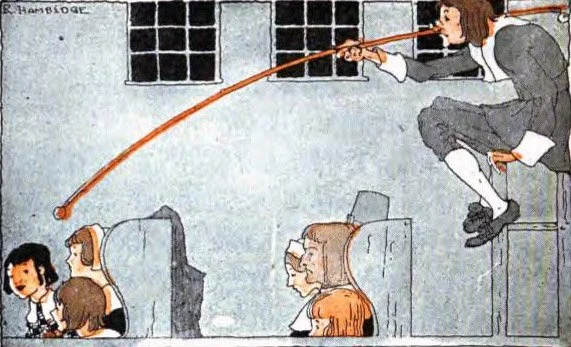
A powerful figure in the dull monotony of Puritan meeting houses was the tithingman, whose task was to enforce the observance of the Sabbath and to preserve order during service. Armed with a knobbed rod in hand, he kept vigil, rapping restless boys on the head to restore order. On the other end of the staff was a foxtail with which he banished the sleep of those who had nodded off.
Description and illustration sourced from: https://historicipswich.net/2024/01/24/tithingman/
HOG REVES
Samuel Felch, Jr.
Josiah Bryant
Jonathan Flint III
Daniel Damon
Jonas Parker Jr.
William Nichols
Benjamin Williams
Hog reves (reeves) duties and responsibilities included:
Catching stray pigs: Pigs often roamed free or broke through weak fences to dig up neighbors' fields. The hog reeve chased, captured, and secured these loose animals.
Enforcing local laws: Towns required owners to put wooden yokes and metal nose-rings on their pigs to stop them from rooting in the dirt. The reeve checked that owners followed this rule.
Impounding animals: Captured pigs were locked in a secure local holding area called a town pound. Owners had to pay a small fine to get their animals back.
Assessing damage: If a loose pig ruined a farm, the hog reeve estimated the financial cost of the ruined crops.
Source: https://thepanorama.shear.org/2024/08/07/lets-give-hog-reeves-their-due/
Image (below): “Hog Reeve” from William Bassett, History of the town of Richmond, Cheshire County, New Hampshire : from its first settlement, to 1882 (Boston: C.W. Calkins, 1884), page 199. Available digitally at https://scholars.unh.edu/history_and_genealogy/60/.